Why cloud assessment needs a decision framework
Many cloud assessments stop at technical facts: programming language, infrastructure footprint, database type, uptime requirements, dependencies, and hosting cost. That information is necessary, but it is not enough. Modernization is ultimately a portfolio decision, not only a technical one.
If a company has dozens or hundreds of applications, the real question is not only can we move this? The real question is should we move this now, how deeply should we invest, and what is the most reasonable modernization path?
This is where business value and pain become powerful together. Business value shows how important an application is to growth, revenue, risk, customer experience, or operational continuity. Pain shows how much the current state is hurting the organization through instability, slow delivery, high support effort, poor scalability, security concerns, compliance issues, or expensive maintenance.
A simple quadrant: business value versus pain
The quadrant is intentionally simple. The horizontal axis is business value. The vertical axis is pain. When applications are mapped in this space, modernization priorities become easier to discuss with both business and engineering stakeholders.
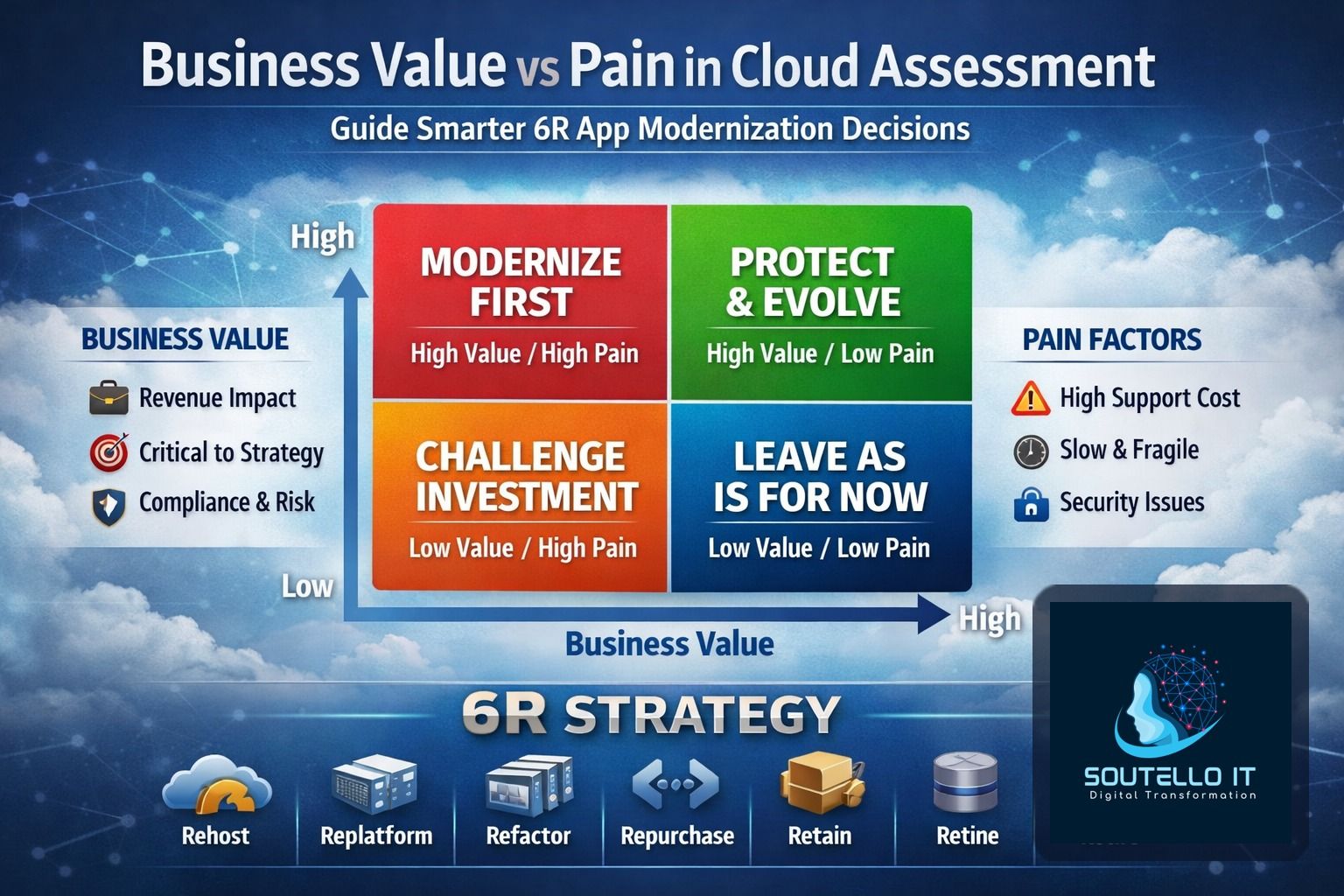
Modernize first
These applications matter a lot and they hurt a lot. They usually deserve the strongest attention because they create both business upside and operational urgency.
Protect and evolve carefully
These systems are important, but they are not currently causing major friction. They may still need modernization, but usually through controlled improvement instead of disruption for its own sake.
Challenge the investment
These applications are expensive, unstable, or difficult to change, but they do not deliver strong strategic value. This is where retaining, replacing, or retiring often becomes more attractive than a deep rebuild.
Leave until a trigger appears
These systems are rarely the first candidates for major modernization. They can often stay as they are until regulation, cost, technology risk, or business change creates a stronger reason to act.
The quadrant is not the final answer. It is the shared lens that helps teams choose the right next conversation.
How to score applications in practice
Business value should be discussed in terms the business understands. Typical indicators include revenue impact, customer experience, process criticality, differentiation, compliance exposure, and how central the application is to future strategy.
Pain should be discussed in terms the delivery and operations teams feel every week. Typical indicators include incident rate, release bottlenecks, dependency on rare skills, infrastructure fragility, slow time to market, poor observability, security weaknesses, and total cost to maintain.
A practical cloud assessment can score each dimension on a simple scale such as 1 to 5. The exact formula matters less than consistency. What matters is that business and technology stakeholders agree on the scoring criteria and understand why one application lands above or below another.
Useful assessment questions
- How critical is this application to revenue, compliance, or customer operations?
- How much delivery speed is being lost because of the current architecture?
- How often do reliability, security, or scalability issues create business friction?
- If we modernize this application, how much measurable value could we unlock?
How the quadrant helps apply the 6R approach
Once the portfolio has been mapped, the quadrant becomes a strong input for the 6R modernization approach. The 6Rs are not just technical patterns. They are investment choices.
Rehost
Useful when speed matters more than redesign. Often relevant for applications with moderate value and pain where infrastructure change is needed quickly.
Replatform
Useful when the application should stay mostly intact but gain better operational characteristics, such as managed services, container platforms, or improved deployment flow.
Refactor
Often best for high-value and high-pain systems where deeper change can unlock major business and delivery benefits.
Repurchase
Strong candidate for lower-differentiation capabilities where a SaaS product can replace costly custom maintenance.
Retain
Reasonable for low-pain systems or for applications that do not yet justify modernization effort.
Retire
Especially important for low-value and high-pain systems that continue to consume budget and attention without clear strategic return.
A useful way to think about it is this:
- High value plus high pain often leads toward refactor, replatform, or targeted rehost as an interim step.
- High value plus low pain often leads toward retain for now with a planned evolution path, or a measured replatform.
- Low value plus high pain often points to retire, repurchase, or a minimal rehost only if necessary.
- Low value plus low pain often supports retain until the business case becomes stronger.
Common mistakes this approach helps avoid
Without this framing, teams often make one of four mistakes: they modernize only what is technically interesting, they ignore painful low-value systems that should be retired, they over-invest in stable systems that are not urgent, or they treat every application as if it deserves the same modernization depth.
The business value versus pain quadrant helps prevent that. It creates a language for prioritization that both leadership and engineering teams can use together. From there, the 6R decision becomes more grounded, more transparent, and more aligned with outcomes instead of hype.
Final takeaway
A good cloud assessment does not end with a spreadsheet. It ends with a clear modernization sequence, a realistic 6R recommendation for each application group, and shared confidence about where to invest first.
Need help with your cloud assessment or modernization roadmap?
If you want support to assess your application portfolio, prioritize modernization with business context, and define the right 6R strategy, hire my services and let us build a practical roadmap together.